Study 001 / P002Version 1 · 2 October 2026

What does
“non-progression”
mean?

A bounded audit of spinal structural outcomes in axial spondyloarthritis trial reports.

Completed descriptive pilot Internally checked Not externally validated

Choose your starting point

The plain-language summary

A small phrase can hide
a different question.

When a study says a person's spinal damage “did not progress”, it sounds as though nothing changed. But studies can draw that boundary in different places. Some definitions allow a small increase in a measured score.

We examined how accessible trial reports defined and measured roughly two years of spinal structural change. The useful result is a way to read those claims more carefully—not a recommendation about which medicine to take.

Changing a cutoff can change how many people are counted as non-progressors. That does not mean their biology changed when the definition changed. See the example below →

This pilot did not rank treatments or demonstrate that existing structural damage can be reversed. Read the limits.

The research summary

Definitions are part
of the result.

Question
Which populations, thresholds, readers and missing-data rules underlie approximately two-year spinal structural endpoints in accessible axial SpA trial reports published in 2018–2026?
Design
A bounded descriptive report audit, with separate matched within-cohort threshold contrasts. No pooled effect or cross-treatment comparison.
Dataset
Nine parent trial families, 46 endpoint rows; four families support five matched contrast rows. MEASURE-1 and ENRADAS share a comparative reading campaign.
Main observation
The percentage classified as non-progressing depends on the exact outcome rule. Matched comparisons preserve population, visit and analysis method; uncertain matches are excluded.
Review status
Pivotal numerical inputs were cross-checked by AI workers who did not extract them. This is internal review, not external scientific validation. Methods and review details →
01 / The record

One question.
A traceable answer.

We wanted an inspectable account of what “non-progression” means in a defined set of spinal structural reports. The dataset records the exact endpoint rule, nominal visit, population, analysis method, source location and reasons for unknown fields.

9parent trial families
46endpoint records
4matched families

These are counts within this bounded audit, not an estimate of all relevant research. Five comparison rows arise because PREVENT contributes two treatment sequences. Endpoint data ↗

The nine accessible families are SURPASS, RAPID-axSpA, MEASURE-1, ENRADAS, PREVENT, SELECT-AXIS-1, SELECT-AXIS-2, CONSUL and ASSERT. Extensions and population strata were kept with their parent trial. Old trials can qualify through reports published inside the audit's 2018–2026 window.
02 / Findings

The same cohort.
A different cutoff.

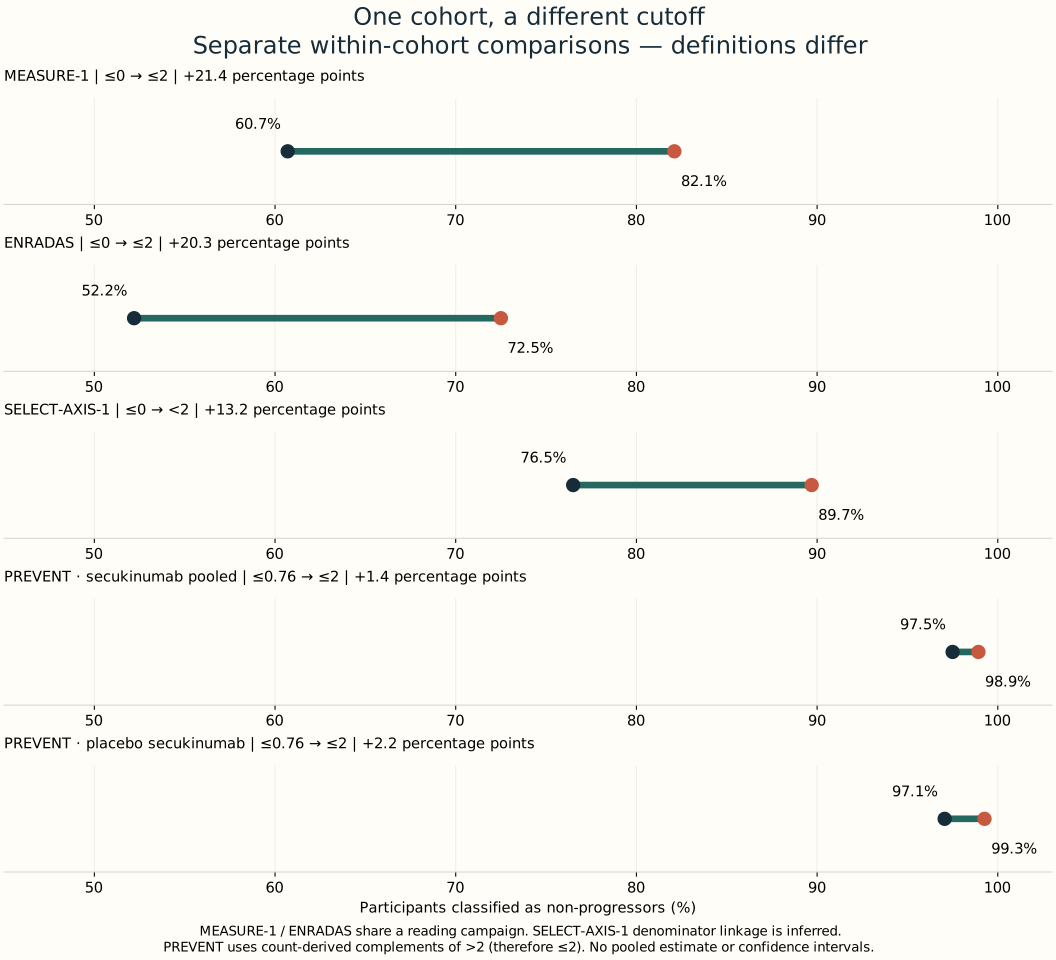
In the MEASURE-1 comparative reading dataset, changing the rule from score change ≤0 to ≤2 changes the reported non-progression rate from 60.7% to 82.1%. That is a 21.4 percentage-point difference obtained by subtracting rounded published percentages. It describes a classification change, not a new treatment effect. Original report, Table 2 ↗

82.1%60.7%21.4percentage points

Other eligible comparisons remain separate because their definitions differ. A strict “<2” rule is not the same as “≤2”. Neither should be silently substituted for the other. The PREVENT upper rate is a count-derived complement of progression >2, so its exact boundary is ≤2. PREVENT report ↗

Five separate within-cohort comparisons: MEASURE-1 60.7 to82.1%; ENRADAS52.2 to72.5%; SELECT-AXIS-1 76.5 to89.7%; PREVENT97.5 to98.9% and97.1 to99.3%. Each has its own exact threshold definition.
Reported or count-derived data, not simulated values. Line lengths are not comparable treatment effects. MEASURE-1 and ENRADAS share a reading campaign; SELECT-AXIS-1 denominator linkage is inferred. No pooled estimate or uncertainty intervals are shown. Sources: MEASURE/ENRADAS, SELECT-AXIS-1, PREVENT. Download figure.
Read the numerical table and denominator caveats
Separate within-cohort contrasts. pp = percentage points.
CohortDefinitionPercentageDifference
MEASURE-1≤0 → ≤260.7 → 82.121.4 pp
ENRADAS≤0 → ≤252.2 → 72.520.3 pp
SELECT-AXIS-1≤0 → <276.5 → 89.713.2 pp
PREVENT · secukinumab pooled≤0.76 → ≤297.5 → 98.91.4 pp
PREVENT · placebo then secukinumab≤0.76 → ≤297.1 → 99.32.2 pp

MEASURE-1 and ENRADAS primary comparison sets contain 168 and 69 participants. SELECT-AXIS-1's n=136 is linked from the common paired imaging cohort and is not independently restated beside the binary rates. PREVENT uses explicit counts: 273/280 and 132/136 at ≤0.76, compared with complements 277/280 and 135/136 at ≤2.

The first three differences subtract rounded rates. PREVENT differences use counts and are rounded here only for display. Excluding SELECT-AXIS-1's inferred linkage leaves three parent families but only two source reading exercises. Full precision and warnings ↗

Reading the result

Stability is not
the same as repair.

A measured score can remain below a progression threshold without showing that an existing lesion has regressed. Repair requires a different outcome: follow the same existing lesion and establish that it changed in the direction specified before the study.

No lesion-specific repair endpoint was identified in the structural material inspected for these nine families. That scoped finding does not establish that repair is impossible or that it has never been studied. Scope of the public record →

03 / Methods

How the audit
was assembled.

  1. Define a manageable scope.

    Accessible reports published from 1 January 2018 through 2 October 2026, with randomized parent trials or their extensions/secondary reports and nominal 96–112-week spinal mSASSS or syndesmophyte outcomes. Actual image windows were recorded separately; a nominal visit does not ensure the same imaging interval across studies.

  2. Search and preserve the limits.

    One EuropePMC title/abstract query returned 42 records, screened by one lab screener. Supplemental discovery added known reports outside that count. An initial 841-result all-fields query was preserved but not screened. This was not a complete systematic review.

    Exact 42-record query
    (TITLE_ABS:"axial spondyloarthritis" OR TITLE_ABS:"ankylosing spondylitis") AND (TITLE_ABS:mSASSS OR TITLE_ABS:"radiographic progression" OR TITLE_ABS:syndesmophyte*) AND (TITLE_ABS:trial OR TITLE_ABS:randomized OR TITLE_ABS:randomised) AND FIRST_PDATE:[2018-01-01 TO 2026-10-02]

    Retrieved 2 October 2026. Eight records were marked include, four companion, two potentially eligible but access limited, two companion but access limited, and 26 excluded/background/outside-report-scope. These are record dispositions, not unique trial-family counts.

  3. Extract what makes a result interpretable.

    Preserve the population, exact inequality, imaging readers, missingness, estimator, nominal week, denominator and source location. When an exact analysis denominator could not be confirmed, it remained unknown. For SURPASS, baseline imaging counts were not relabeled as endpoint analysis counts.

  4. Challenge before calculating.

    Separate AI workers checked pivotal source entries they had not extracted, with orchestrator adjudication. This was not duplicate independent screening or complete independent re-extraction of every field, and it was not external expert validation. Comparisons with uncertain population or estimator linkage were excluded.

  5. Make only the supported calculation.

    Five matched within-cohort contrasts were retained. No common effect was pooled and no drugs were ranked. Registry histories, some supplements and publication-status checks remained incomplete; the bounded release amendment makes these unfinished components explicit.

04 / Limits

What remains
unanswered.

This pilot is an incremental interpretation dataset. It does not establish novelty, comprehensive coverage, comparative treatment efficacy or clinical significance of the numerical differences.

Coverage. A limited single-database search, single screening and accessible-source selection can omit relevant evidence. POSTURE, BE-MOBILE-2 and the pooled COAST-V/W report remained access limited.

Comparability. Imaging windows, patient populations and outcome rules differ. MEASURE-1 and ENRADAS are separate parent cohorts but not independent methodological replications.

Review. Correlated AI checking is a useful error-catching step, not qualified external scrutiny. Historical registration concordance and full supplement/status review remain unfinished.

What would change the result. A source correction, or a hidden difference between paired populations, images or estimators, would require withdrawing and recalculating the affected contrast.

Our proposed checklist for a future repair study

Methodological proposal, not a validated outcome standard.

  1. Define the existing lesion precisely; distinguish squaring, syndesmophytes and mature bridges.
  2. Identify the same lesion on comparable baseline and follow-up images.
  3. Prespecify lesion-level regression, separate from prevention or a composite-score decrease.
  4. Blind readers, quantify disagreement and prespecify adjudication.
  5. Track missing participants, images and scored locations separately.
  6. Distinguish measurement error from biological change and group-effect uncertainty.
  7. Seek corroboration and qualified external imaging/methods review before a strong repair claim.
05 / Open record

Follow the evidence.

The public files include source locations and reasons for unknown values. They contain extracted study facts and lab-written documentation, not patient-level data or copies of full papers.

Download reproduce.py and p002-comparisons.json into the same folder, then run python reproduce.py. This reproduces the five descriptive differences; it does not rerun literature retrieval or certify source interpretation.

Principal sources

  1. MEASURE-1 / ENRADAS comparative radiographic report. Table 2 primary sets; full text inspected.
  2. PREVENT two-year imaging outcomes. Full text inspected; the exact count-derived complement is ≤2.
  3. SELECT-AXIS-1 two-year report. Full text inspected; binary denominator linkage retained as an inference.
  4. CONSUL structural progression report. Full text inspected; primary continuous estimate, no eligible matched binary contrast.
  5. Complete endpoint-level source links and locations. Remaining family reports and extracted methods; no claim that every supplement or historical registry version was inspected.

Version & attribution

SpA Lab, What does “non-progression” mean? P002, version 1, 2 October 2026. Public presentation of a completed bounded descriptive pilot. Original study results remain attributable to the cited investigators. No journal publication or external peer review is claimed.

Version 1: initial public release. Substantive future corrections will be recorded here.