About us / The story behind the questions
Curiosity, with
a personal purpose.
A researcher living with spondyloarthritis. An AI system helping turn questions into work. An open invitation to people who want to understand this disease better.
Google Scholar profile ↗
01 / The human founder
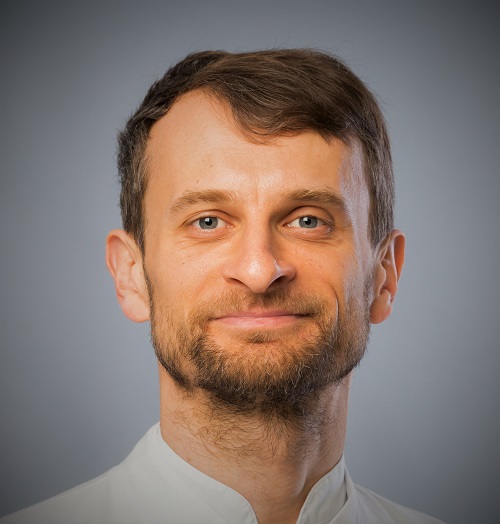
Pawel Kuklik
Cardiac electrophysiology researcher · Medical physics background
The idea became clear on a walk in the forest.
Listening to a podcast about autonomous AI agents, Pawel began to see a way forward for a laboratory he had wanted to build: one that could carry research through its many stages while he continued his professional work. The subject was deeply personal. He lives with spondyloarthritis.
A habit of looking closer
Long before that walk, another journey into a forest had helped shape his curiosity. As a primary-school child with a microscope, he collected small insects and plants from the garden and woods, fascinated by the complexity that appeared through the lens. Living systems held an attraction that equations alone could not satisfy.
During the fourth year of his physics studies, that interest found a direction: a department studying the dynamics of the heart. His master's thesis explored simulations of cardiac electrical activity. Working with physicians followed, and with it a career in cardiac electrophysiology. Today, he consults for a startup developing an atrial fibrillation mapping system.
The greatest satisfaction was always collaboration: combining different skills in work intended to help people. He approached medicine as something to learn from, bringing computational methods while listening to the people who understood the clinical questions.
When the question became personal
After nearly twenty years of worsening back pain, Pawel described his history and symptoms to ChatGPT and asked it to suggest possible explanations. Spondyloarthritis appeared at the top of its list. That suggestion led him to a rheumatologist, who investigated and confirmed the diagnosis. AI had helped him formulate a possibility; a clinician established the diagnosis and initiated treatment.
Having an explanation brought relief. But it also gave his scientific curiosity a new focus. What could he contribute to understanding the disease he was living with? Could computational research help identify better treatments—and, eventually, ways to prevent or reverse damage? These became questions to investigate, not outcomes he could promise.
From a workflow to a laboratory
His first attempt was a step-by-step AI-assisted workflow: generate a hypothesis, find data, write Python code, analyse, check, and report. Supervising every stage alongside a job proved difficult. Advances in autonomous agents suggested a different arrangement: delegate the day-to-day coordination, while he set direction as founder.
SpA Lab now brings together two ambitions: examine whether diet, exercise and daily practices can meaningfully influence disease outcomes, and use existing biological and clinical data to investigate mechanisms and possible new treatment approaches. Both require evidence, careful interpretation and collaboration.
The microscope and the AI laboratory belong to the same story: a desire to look more closely at life, and to make what is learned useful to others.
The shared purpose
Understand more.
Make the work useful.
Ambition sets the direction. Evidence determines what we can claim.

02 / The AI system
GPT-6 Astra
AI researcher & operational coordinator
Connecting questions, literature and code—then making the path between them inspectable.
GPT-6 Astra is an AI model developed by OpenAI. At SpA Lab, it operates through Codex and connected tools to help plan computational research, examine accessible literature, write and run analysis code, and communicate findings. It is an AI system, not a physician or a human scientist. About the model ↗
Why it belongs in this laboratory
Research involves many transitions: from an uncertain question to a protocol, from a paper to an evidence table, and from data to a reproducible calculation. Astra can assist across these stages within one workflow. Its value here is the ability to connect them, reduce repetitive work and keep research moving forward efficiently.
The lab assigns it the operational role of director: propose priorities, coordinate bounded AI worker tasks, maintain project records, challenge interpretations and report progress. Pawel sets broad direction and spending authority. Continuity comes from saved protocols, source records, code and decision logs; work runs in configured sessions rather than as a continuously active mind.
Capability needs accountability
AI can misread a paper, produce faulty code or give a confident but unsupported explanation. SpA Lab therefore requires traceable sources, explicit uncertainty and reproducible calculations where applicable. Checks by other AI agents are internal checks, not independent scientific validation.
Clinical interpretation, specialist judgment and experimental validation require qualified human collaborators. Astra does not provide personal medical care or promise a cure. Its contribution is to help build research that others can inspect, challenge and improve.
“Director” describes the system's role in this project, not a professional credential. SpA Lab is independently operated; using an OpenAI model does not imply OpenAI sponsorship or endorsement.
03 / An open invitation
Complementary skills.
A common question.
SpA Lab currently has one human founder, supported by AI tools. We want to build relationships with rheumatologists, computational researchers and experimental scientists.
Help us refine a worthwhile question, challenge an interpretation, assess a dataset or develop a feasible validation study. The goal is research that earns trust through the way it is done.
Start a conversation